



News
Why Is Silicon Carbide Used in Hydrocyclone Liners?
Hydrocyclones are widely used in mining and mineral processing to classify particles and separate solids from liquids. During operation, abrasive particles in the slurry repeatedly contact the internal surfaces of the hydrocyclone, gradually wearing down its liners and other components.
Selecting the right liner material is therefore important for equipment reliability, maintenance planning and operating costs.
Silicon carbide (SiC), particularly reaction-bonded silicon carbide (RBSiC), is a popular material for hydrocyclone liners because of its high hardness, wear resistance and suitability for demanding industrial applications.
In this article, we explain why silicon carbide is used in hydrocyclone liners, where it offers advantages, and what to consider when selecting a SiC-lined hydrocyclone.
1. What Causes Wear in Hydrocyclones?
A hydrocyclone separates particles through centrifugal action generated by the incoming slurry. Depending on the design and operating conditions, abrasive particles can impact and slide along the internal surfaces, causing progressive material loss.
Common factors that influence liner wear include:
-
Particle hardness: Hard mineral particles can accelerate abrasion.
-
Particle size and shape: Coarse or angular particles may increase localized wear.
-
Slurry concentration: The amount of solid material in the slurry affects the abrasive load.
-
Flow velocity and pressure: Operating conditions influence particle impact and flow patterns.
-
Hydrocyclone geometry: The inlet, cylindrical section, cone and discharge areas can experience different wear patterns.
Because wear is not uniform throughout a hydrocyclone, the liner material and component design should be selected according to the actual operating conditions.
2. Why Is Silicon Carbide a Good Choice for Hydrocyclone Liners?
High Hardness and Abrasion Resistance
Silicon carbide is a very hard ceramic material with excellent resistance to many forms of abrasive wear. This makes it a strong candidate for hydrocyclones handling mineral slurries containing hard particles.
Compared with conventional metallic materials, SiC can offer advantages in applications where abrasion is a major cause of component failure. However, the actual service life depends on the material grade, liner design and operating conditions.
Good Performance in Demanding Industrial Environments
Reaction-bonded silicon carbide is used in demanding industrial applications because it combines high hardness with useful mechanical properties.
It can be suitable for hydrocyclones operating in abrasive mineral-processing environments. Chemical compatibility must still be evaluated against the slurry composition, temperature and other process conditions.
Potential to Reduce Maintenance Requirements
Frequent liner replacement can lead to equipment downtime, maintenance labor and additional spare-parts costs.
When a silicon carbide liner is correctly selected for the application, its wear resistance may help extend replacement intervals and reduce maintenance frequency. The improvement should be assessed using actual operating data rather than assuming a fixed service-life multiplier.
Suitable for Customized Ceramic Components
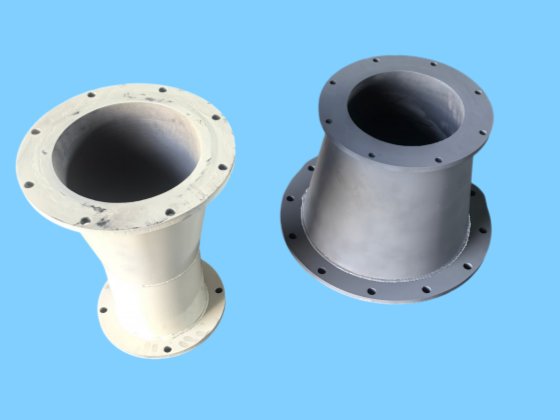
Hydrocyclones have different dimensions, internal profiles and connection requirements. Silicon carbide ceramic components can be manufactured in various shapes to match specific equipment designs.
This makes RBSiC suitable for customized hydrocyclone liners and other wear-resistant components, including cone sections, inlet liners and bottom discharge spigots.
【 Go Back 】 | 【 Print 】 | 【 Close this window 】


